


 Back
Back  Blog
Blog


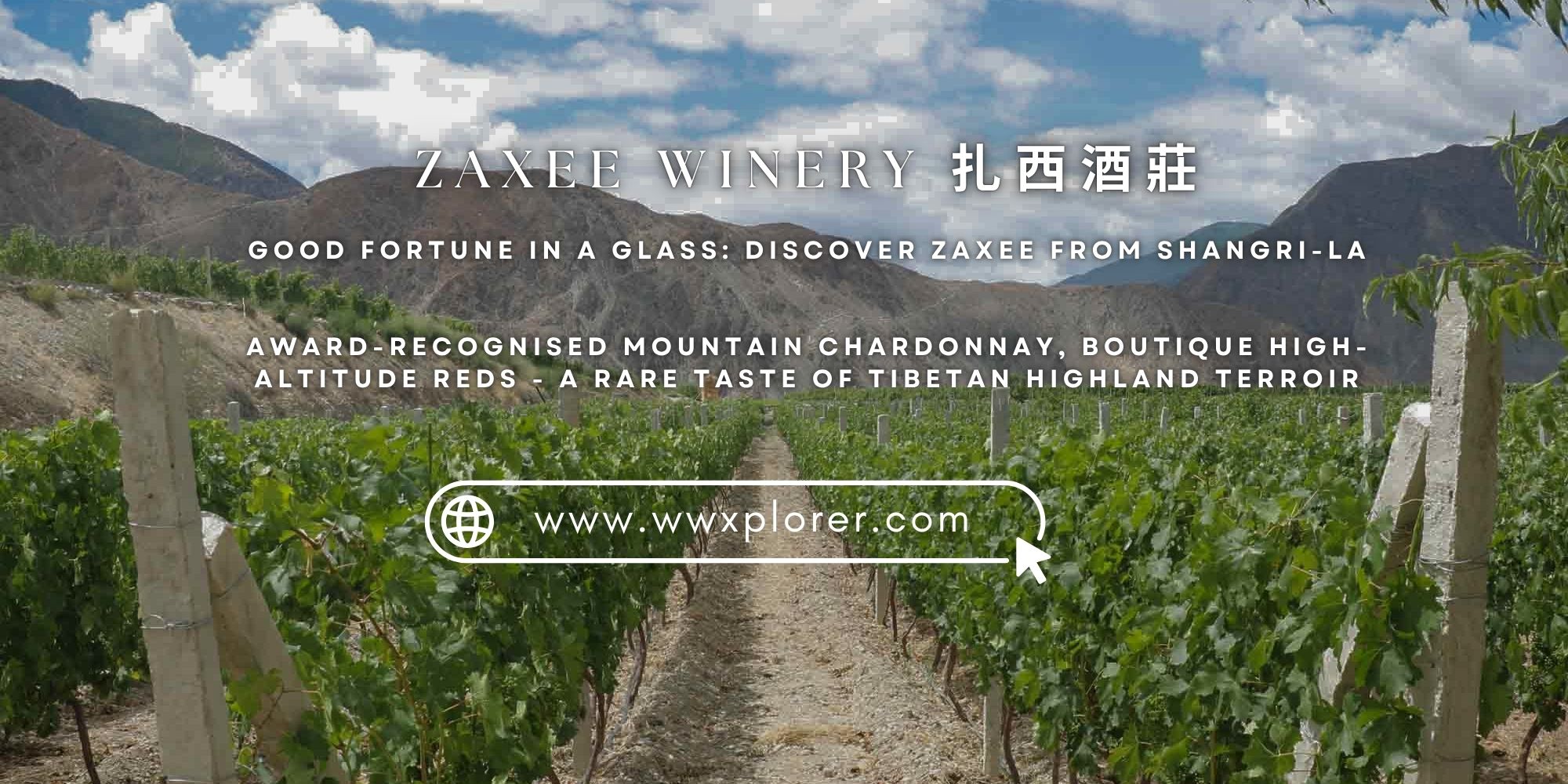
A Wineworld Xplorer special feature — an intimate conversation with the founder of China’s highest-altitude winery.
ZAXEE produces fewer than 30,000 bottles a year from vineyards perched between 2,300 and 2,750 metres in the Hengduan Mountains of Yunnan — China’s highest-altitude boutique winery. Every grape is hand-selected. No machinery can navigate the slopes. The winery itself is a converted 500-year-old Tibetan cattle shed in Hachong Village, Benzilan Township, Deqin County. You walk ten minutes from there to the vines, and fifty minutes down the highway toward Meili Snow Mountain.
The name “Zaxee” (扎西) comes from the Tibetan greeting “Tashi Delek” — auspiciousness, good fortune, happiness. It’s the first thing Tibetan people say when they meet. The winery’s guiding ethos is “Pure Highland Soil, Natural Energy” (净土·自然能量): organic farming, yak manure fertiliser, zero pesticides, hand-harvesting, berry-by-berry selection, glacial snowmelt irrigation from the surrounding peaks.
But the story of ZAXEE is not really about altitude, or technique, or even the wines themselves. The story is the man behind them.
“Selling Someone Else’s Wine Is Never Truly Your Own”
Quan Shiping (全世平) studied oenology at Northwest A&F University, one of China’s most respected wine institutions. After graduating, he did what many graduates do — he started selling wine. Other people’s wine. From everywhere. For years.
Mariana: You were selling wine from all over the world. What made you stop?
Quan Shiping: 卖全世界任何地方的酒,永远不是自己的东西 — “Selling someone else’s wine, no matter where in the world it comes from, is never truly your own thing.” I studied oenology for four years. And my university teacher told us: 中国一定有超过法国超过意大利的好产区 — “China definitely has terroir that can surpass France and Italy.” So I stopped selling. I went looking.
In 2015, he made his first trip to Shangri-La. What he found was not a postcard vineyard. It was a rocky, sun-scorched hillside covered in gravel and sand. Wild vines grew there — against all odds — and the fruit they bore was remarkably sweet.
Quan Shiping: 那个地方农民什么都不懂。全是石头。太阳又很晒。但是葡萄很甜。我说:这种条件下都能做出好的葡萄酒,如果加以专业的指导种植酿造,岂不是会更好? — “The farmers there didn’t know anything. The soil was terrible — all stones. The sun was relentless. But the grapes were sweet and they thrived. I thought: if they can do this without any guidance, what could we achieve with proper viticulture and winemaking?”
By 2017, the first ZAXEE vintage was born.
A Philosophy That Refuses to Impose
What separates ZAXEE from China’s growing crowd of premium wineries is not altitude — it is a philosophy so radical in its simplicity that it sounds almost spiritual:
Quan Shiping: 我不会酿跟别人一样的酒。我也不会酿我自己想喝的酒。我会酿土地长出来的酒。让葡萄成为葡萄。让葡萄酒成为葡萄酒。 — “I don’t make wine like anyone else. I don’t even make the wine I personally want to drink. I make the wine that the land grows. Let the grape be the grape. Let the wine be the wine.”
This is not marketing. It’s a practice — visible in every choice the winery makes.
每个生命都有自己的意义,自己的归宿。葡萄要承载它的意义。就像扎西要承载扎西的意义,松赞要承载松赞的意义。 — “Every life has its own meaning, its own destination. The grape must carry its meaning. Just as Zaxee must carry Zaxee’s meaning, and Songzan must carry Songzan’s.”
The Wines: A Journey in Four Acts
Quan presents his wines not as a catalogue but as an experience — a progression that moves from joy through reverence to complexity, mirroring the landscape itself.
Act I: Sparkling Rosé — “I’m So Happy to See You”
Quan Shiping: 扎西就是见到你很开心。跳跃的颜色,愉悦的颜色,跳跃的气泡,轻松的感觉。通过这杯酒,就能够轻松进入到相对熟悉的环节。 — “Zaxee is ‘I’m so happy to see you.’ The jumping colour, the joyful colour, the dancing bubbles, the easy feeling. Through this glass, we move naturally from strangers to familiar.”
100% Syrah from Yeri Village, Deqin, at 2,500 metres. Natural secondary fermentation in bottle, no disgorgement, no filtration. Pale pink, lively, effortlessly approachable. No decanting. Just pour and begin.
Act II: Songzan Chardonnay — The Wine Between Two Snow Mountains
Quan Shiping: 这款酒在的葡萄园是在2750米的红坡村。背朝白马雪山,面朝梅里雪山,两个雪山的中间。 — “This wine’s vineyard is at Hongpo Village, 2,750 metres. Behind it, Baima Snow Mountain. Before it, Meili Snow Mountain. Between two snow mountains.”
This may be the most compelling wine in the portfolio. 100% Chardonnay from one of the highest vineyard sites in China, aged six months in French oak.
特别干净,非常让人肃然起敬。虽然相对清瘦一点,但在口腔里面很悠长。 — “Exceptionally clean. It commands a kind of reverence. Relatively lean, but it lingers on the palate — very, very long.”
It has international structure but a distinctly high-altitude soul: cool, mineral, transparent. This is not a Chardonnay that shouts. It holds your gaze.
Act III: Orange Wine — The Energy in the Skin
Quan Shiping: 葡萄最好的养分在葡萄皮里面。天天接受紫外线阳光照射,根系给它营养——葡萄皮蕴含着很多能量。我希望把葡萄皮里面好的东西酿在酒里面。 — “The finest nutrients are in the grape skin. It has absorbed ultraviolet rays and sunlight every single day, nourished by the root system — the skin carries enormous energy. I wanted to capture that energy in the wine.”
100% Chardonnay from Ruiwa Village, Deqin, at 2,700 metres — at the foot of Meili Snow Mountain. Fermented on skins in terracotta jars for 15 days, aged 18 months in clay. Unfiltered. Unfined. The first orange wine ever made in Shangri-La.
Orange-gold. Citrus blossom, white flowers, kumquat. The texture is almost red-wine-like, yet the tannins remain delicate. And it changes — continuously:
喝到这个香气,它就没了。但是过一会儿,它又回来了。 — “You catch the aroma, and it’s gone. But a moment later, it comes back.”
Decant 20–30 minutes. Let it breathe. Let it surprise you.
Act IV: Grand ZAXEE 2560 — The Flagship
The summit. From the Jinsha River Valley in Garze Tibetan Autonomous Prefecture at 2,560 metres. 100% Cabernet Sauvignon. Hand-picked, double-sorted, extended skin contact for 25–30 days, 12 months in French oak, 6 months bottle ageing. Ageing capacity: 20 years.
Deep ruby. Blackberry, dried plum, pine resin, roasted mulberry, caramel, vanilla. Tight on entry, crisp acidity, firm but not aggressive tannins. After two hours of decanting, the wine transforms — tannins soften to silk, the finish stretches long and complex. Awarded at Decanter and Brussels. Featured in the China Wine Yearbook. This is Chinese high-altitude Cabernet Sauvignon at its most compelling.
From Hong Kong to Meili Snow Mountain
The most memorable moment in our conversation came not from talking about wine, but from drinking it — paired with food.
Quan Shiping: 今天我们搭配的菜单,把这三款酒从香港的海平面升到了梅里雪山六千多米的海拔。这是餐酒搭配的魅力。 — “Today’s menu lifted these wines from Hong Kong’s sea level to Meili Snow Mountain’s 6,000-metre peak. That is the magic of food and wine pairing.”
It is also the magic of ZAXEE’s positioning. A wine born in Tibet, poured in Hong Kong, telling a story that needs no translation — because it speaks the language of place.
What Quan Shiping is building in the Hengduan Mountains is not just a winery. It is an argument — made in terracotta and granite, in Syrah skins and snowmelt — that Chinese wine does not need to look to Bordeaux or Napa for its vocabulary. It already has one. It’s called Shangri-La.
Quan Shiping: 每多酿一年酒,多在那个地方待一年,我的认识就不一样。表达就会更准确,更充分。所以肯定会越来越好。中国葡萄酒也会越来越好。 — “Every year I make wine here, every year I spend on this land, my understanding deepens. The expression becomes more precise, more complete. It will only keep getting better. Chinese wine will only keep getting better.”
ZAXEE wines are available through Wineworld Xplorer. For inquiries, visit wwxplorer.com.
All images courtesy of ZAXEE Winery.
