


 Back
Back  Blog
Blog


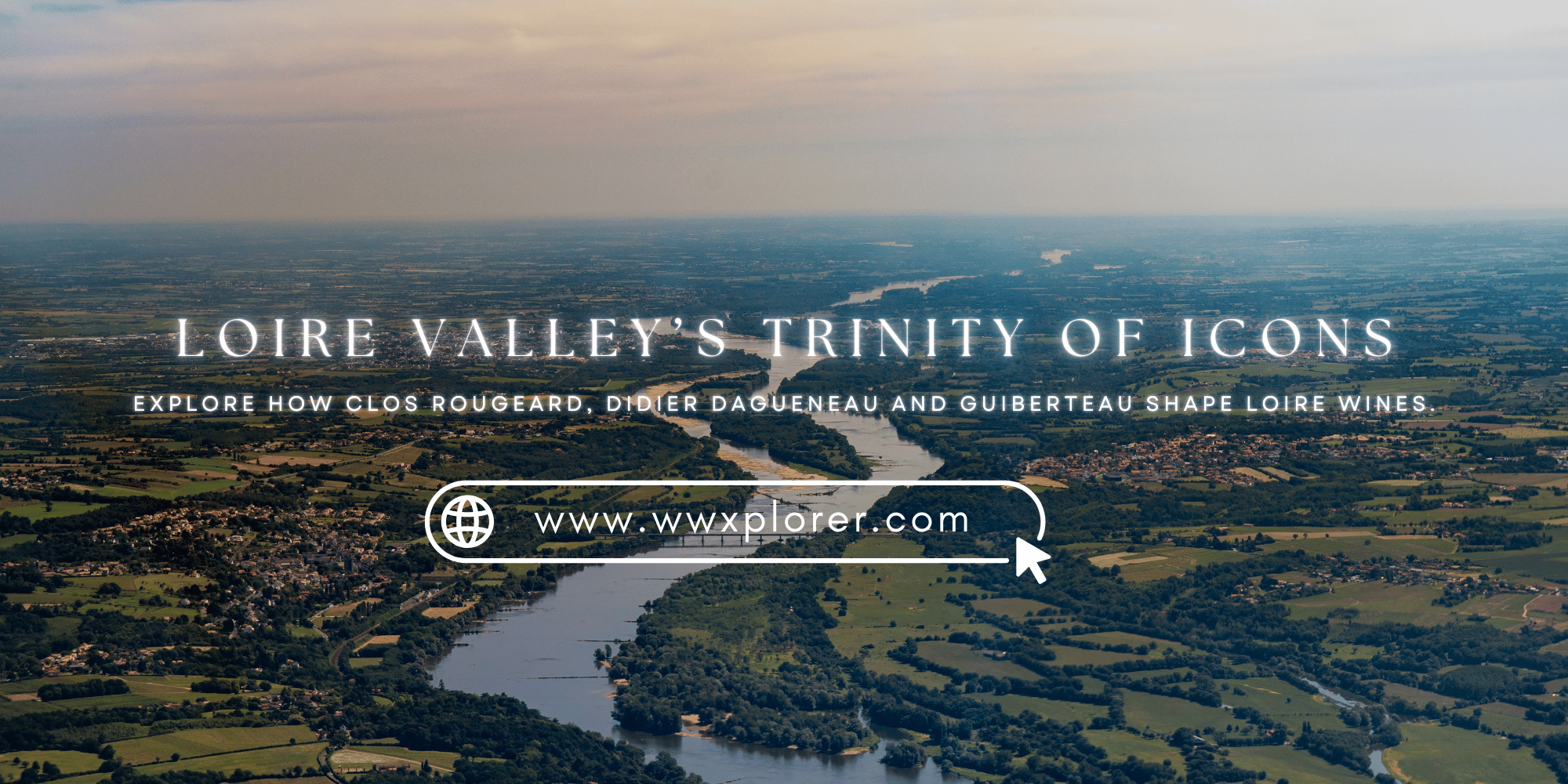
The Loire Valley, often celebrated for its picturesque châteaux and agreeable, early-drinking wines, harbors a deeper, more profound narrative. This is a story of three revolutionary estates—Clos Rougeard, Didier Dagueneau, and Domaine Guiberteau—that shattered preconceptions and dragged their appellations toward a destiny of world-class reverence. They form a trinity representing past, present, and future: the foundational masters, the volcanic disruptor, and the eloquent heir. Their journeys, rooted in a fierce commitment to terroir, have forever altered the landscape of French fine wine.
Clos Rougeard: The Silent Foundation
The story of modern Loire excellence begins not with fanfare, but in the profound silence of the caves beneath Saumur-Champigny. Here, the brothers Jean-Louis and Bernard Foucault, known simply as “Charly” and “Nadi,” tended to their family estate, Clos Rougeard, with monastic dedication from the 1960s until Charly’s passing in 2015. Their history was one of quiet, uncompromising obsession. Rejecting the prevailing post-war trend for high-yield, commercial wines, they pursued a vision of ultimate purity and longevity.
Their winemaking style was deceptively simple, yet required superhuman effort in the vineyard. They farmed 15 hectares of Cabernet Franc and a tiny plot of Chenin Blanc (Le Brézé) with what would now be called organic and biodynamic principles, decades before such terms were fashionable. Yields were slashed to minuscule levels, harvests were exceptionally late, and sorting was meticulous. In the cellar, intervention was scorned. Fermentations were wild and slow in old oak foudres, élevage extended for 18-24 months in neutral barrels, and sulfur use was minimal. The result was Cabernet Franc unlike any other. Instead, they possessed a haunting, Burgundian nose of violets, crushed rock, truffle, and wild berries, with a texture of pure silk and tensile strength. They were profound, age-worthy, and ethereal, achieving a cult status that saw them traded alongside Grand Cru Burgundy and First Growth Bordeaux.
Le Clos, made from 15 clayey-limestone plots in Saumur-Chapigny, preserves the crisp fruit of the Cabernet Franc and expresses often delicate and spicy floral notes. Les Poyeux is made up of a plot of 3 hectares of vines right in front of the estate. Based on a gently sloping hill, this location offers a rare terroir in the Saumur-Champigny appellation, combining clays and draining Aeolian sands. This terroir is particularly favourable to Cabernet Franc. This cuvée expresses finesse and reveals sometimes floral notes sometimes small red fruits notes. Located in the heart of the village of Chacé, Le Bourg is composed of very old vines and lies on a predominantly limestone terroir on shallow clay loam, typical of the Saumur-Champigny appellation. This wine reveals riper, fleshier fruit and a dense, full-bodied texture.
The evolution of Clos Rougeard was internal and qualitative, a slow burn that eventually lit the beacon for the entire Loire. Their 2017 sale to the Bouygues family caused shockwaves, but the legacy was secure: they had proven unequivocally that the Loire Valley was capable of producing some of the planet’s most sublime and cerebral wines.
Didier Dagueneau: The Visionary Disruptor
If the Foucaults worked in sacred silence, Didier Dagueneau of Pouilly-Fumé was a thunderclap. A former motorcycle racer and sled-dog musher, Dagueneau brought a rebellious, uncompromising energy to an appellation grown comfortable on the reliable, if unexciting, merits of Sauvignon Blanc. His history is one of intentional confrontation. Arriving in the vineyards in the early 1980s, he saw complacency and set out to destroy it. His goal was not to make a good Pouilly-Fumé, but to make a great white wine that happened to be from Pouilly.
Dagueneau’s winemaking style was radical, obsessive, and theatrical. He relentlessly reduced yields, eventually planting at densities of up to 12,000 vines per hectare (triple the norm). He embraced biodynamics for its holistic vitality, farmed horses for plowing, and designed his own, more efficient, oval-shaped barrels (cigares) to refine the élevage. In the cellar, he was a meticulous technician, using multiple picks for each parcel, employing indigenous yeasts, and avoiding malolactic fermentation to preserve searing acidity and purity. His vineyard-specific cuvées, like the flinty Silex, the opulent Pur Sang, and the mesmerizing Astéroïde (from ungrafted, pre-phylloxera vines), were revelations. Not to be missed are his single vineyard Sancerre Le Mont Damne and En Chailloux. For those craving an introduction to Didier Dagueneau, the multi-vineyard blend Blanc Fume de Pouilly fuses the terroir of “silex” and “marl” together to give a well-rounded, versatile expression of Sauvignon Blanc.
Overall speaking, these were Sauvignon Blancs of unprecedented concentration, depth, and mineral intensity, with power and complexity that invited comparison to Grand Cru White Burgundy. Dagueneau’s evolution was meteoric and external, forcefully dragging his appellation into the global spotlight. His tragic death in 2008 could have ended the story, but the domaine, now run by his son Benjamin, has not only maintained the standard but continues to refine it. Benjamin has brought a slight softening of edges, a touch more textural harmony, while upholding the fanatical standards in the vineyard. Didier Dagueneau’s legacy is that of a permanent revolution, proving that even the most familiar grape, in a seemingly settled place, could achieve the extraordinary.
Domaine Guiberteau: The Articulate Heir
The thread connecting these stories finds its contemporary expression at Domaine Guiberteau in Samur. Romain Guiberteau, who took over his family’s estate in 1996, represents the next generation—one that learned from the icons and forged its own distinct voice. His history is one of conversion and intellectual pursuit. Initially selling grapes to the local cooperative, a taste of Clos Rougeard in the late 1990s was an epiphany. It revealed the potential of his own terroir, particularly the revered Brézé hill, home to some of the Loire’s greatest Chenin Blanc vines.
Guiberteau’s winemaking style synthesizes the lessons of his forebears with a modern, articulate precision. Like the Foucaults, he believes in minimal intervention, native yeasts, and long élevage. Like Dagueneau, he is a passionate advocate for organic and biodynamic farming, with a laser focus on vineyard health. His genius lies in translating the specific vibrations of limestone and tuffeau into the bottle. His Chenin Blancs, especially the Clos des Carmes monopole and the Brézé bottlings, are masterclasses in tension. They offer a dazzling interplay of intense ripe fruit, searing acidity, and a crushed-rock salinity, achieving a weightless intensity and laser-sharp focus. His Cabernet Francs are similarly vibrant and digestible, all purity and fragrance. The evolution of Domaine Guiberteau has been one of rapid ascension and refinement. Romain has meticulously replanted vineyards, extended élevage, and honed his understanding of each parcel. He is not recreating Clos Rougeard; he is expressing the same hallowed terroirs with a brighter, more immediate, and radiant energy. He stands as the philosophical bridge, proving that the legacy of the Loire’s pioneers is not about imitation, but about the continued, intelligent pursuit of place.
Together, this trinity charts the Loire’s journey to the pinnacle of fine wine. Clos Rougeard provided the foundational proof of potential, creating the template for profound, age-worthy Loire wine. Didier Dagueneau provided the explosive force of will, rewriting the rules of an entire appellation through sheer audacity and vision. Domaine Guiberteau embodies the mature realization of that potential, combining deep respect for tradition with a clear, contemporary voice. They remind us that great wine is born from a confluence of exceptional terroir and human character—whether expressed in silence, rebellion, or eloquent conversation. Through their dedication, the Loire Valley is no longer merely a region of pretty wines, but a sacred source of some of the most compelling and soulful bottles on earth.
